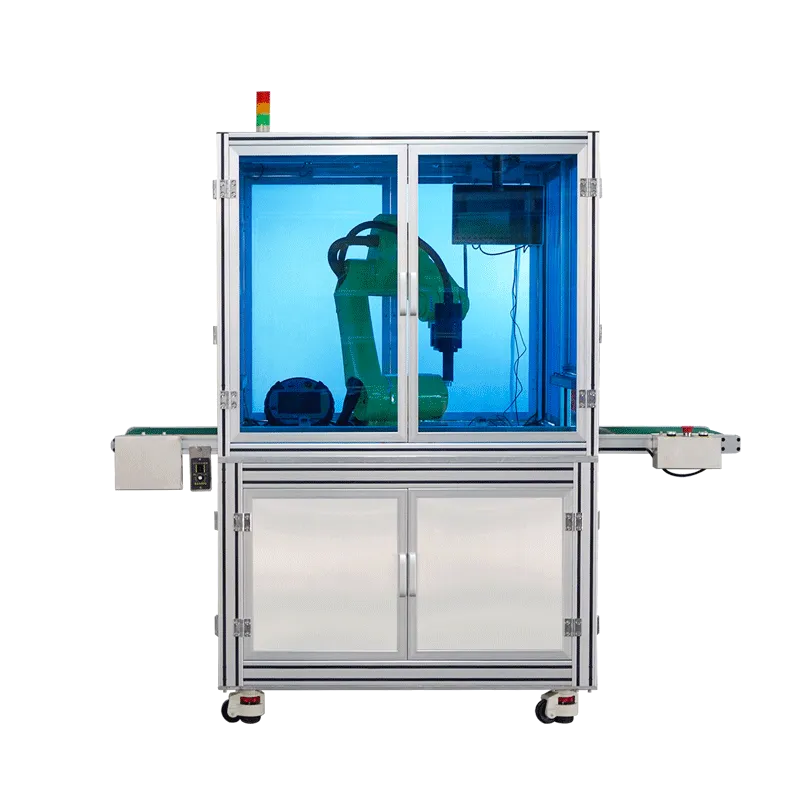
A robotic arm is a sensible and advantageous option for integrating with a plasma treater in manufacturing and industrial settings when the following factors are present:

1. Need for Precision and Repeatability:
- Intricate or Complex Designs: Robotic arms are ideal for applications requiring high precision and intricate path following that would be difficult or inconsistent for manual operations.
- Consistent Quality: Robots ensure uniform and consistent plasma treatment, minimizing variations in surface properties and improving product quality.
- Repeatable Processes: When high throughput and reproducible results are crucial, robotic arms provide reliable automation that eliminates human error and ensures consistency over long production runs.
2. Increased Efficiency and Productivity:
- Higher Throughput: Robotic arms can operate continuously without breaks, significantly increasing production speed and throughput.
- Faster Operations: Robots perform tasks at a faster rate than human workers, leading to reduced cycle times and improved efficiency.
- Reduced Labor Costs: Automating the plasma treatment process with a robotic arm can lead to savings in labor costs.
3. Improved Safety:
- Reduced Exposure to Hazards: Robotic arms can handle hazardous materials and perform operations in potentially dangerous environments (e.g., high temperatures), protecting human workers from exposure to fumes, sparks, and heat.
- Minimized Risk of Injury: Automation eliminates the risk of repetitive motion injuries and other physical strains associated with manual plasma treatment processes.
4. Complex or Large-Scale Applications:
- Processing of Large Components: Robotic arms are well-suited for handling and treating large workpieces and components.
- 3D Treatment: Robot-guided plasma treatment can modify the surface chemistry of three-dimensional components, offering greater flexibility and control compared to traditional methods.
5. Seamless Integration into Existing Production Lines:
- In-line Processing: Robotic plasma treaters can be integrated into existing production lines, eliminating the need for complex chamber systems and streamlining the manufacturing process.
- Compatibility with End-of-Arm Tooling: Plasma units can be designed to be compatible with robotic end-of-arm tooling, facilitating automated loading and unloading of parts.
In summary, a robotic arm for a plasma treater is a valuable investment when manufacturers prioritize precision, speed, consistency, safety, and seamless integration into their production processes.
Please contact Keylink Technology if you would like assistance in selecting a plasma and robot arm system based on your application, as well as for plasma integration into an existing Manufacturing Line.