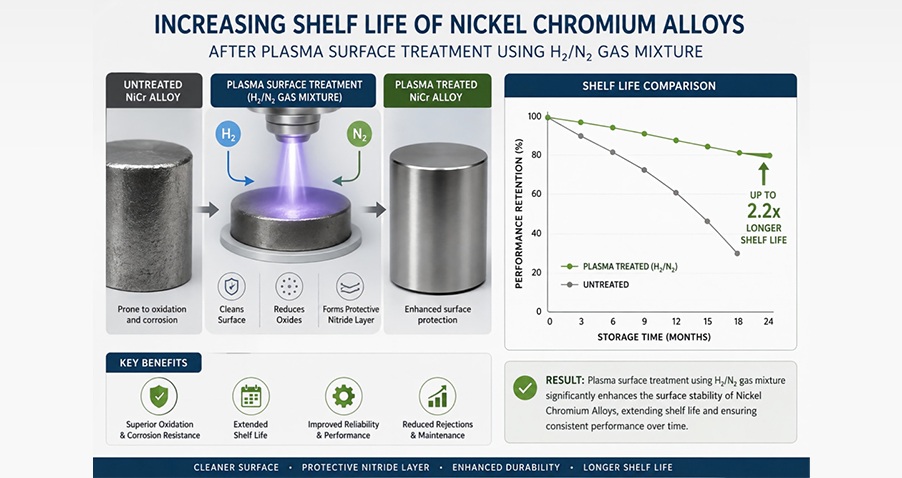
Surface contamination on nickel-chromium alloy materials is a common challenge in manufacturing processes that require reliable bonding, coating, printing, or welding performance. Oils, rolling residues, organic contaminants, and oxidation layers can significantly reduce surface energy, resulting in poor adhesion and inconsistent product quality. A leading manufacturer of nickel-chromium alloy sheets and rolls sought an efficient, inline cleaning solution capable of operating at high production speeds while maintaining consistent treatment quality.
To address this challenge, Keylink implemented an advanced atmospheric plasma surface treatment system equipped with a specially designed rotating plasma torch (H2 Deoxidizer Plasma Torch). The rotating torch features a plasma flame diameter of 40 mm, providing highly uniform treatment across the material surface. For applications requiring wider treatment areas, plasma torches with treatment widths up to 100 mm are available.
The process was developed for nickel-chromium alloy material containing 75% Ni, 16% Cr, 4.5% Al, and 0.5% Ti, with a material thickness of 0.3 mm. Using a controlled process gas mixture consisting of 5% H2 and 95% N2 , the plasma system effectively removed surface contaminants while simultaneously activating the metal surface.
A single rotating plasma torch achieved processing speeds ranging from 2 m/min up to 50 m/min, depending on the selected gas mixture and required cleaning intensity. The non-contact atmospheric plasma process eliminated the need for wet chemical cleaning methods, reducing environmental impact and simplifying production operations. The system was easily integrated into existing roll-to-roll production lines without major modifications.
For customers requiring even higher throughput, additional plasma torches can be installed in a vertical arrangement. By utilizing two or three plasma torches, processing speeds exceeding 100 m/min can be achieved while maintaining excellent cleaning performance and treatment uniformity.
The effectiveness of the plasma treatment was verified through contact angle measurements. Prior to treatment, the nickel-chromium alloy surface exhibited a contact angle of ≥91.9°, indicating low surface energy and significant contamination. Following plasma treatment, the contact angle was reduced to ≤12.8°, demonstrating a dramatic increase in surface wettability and cleanliness.
This substantial improvement in surface energy enabled enhanced adhesion performance for subsequent manufacturing processes. Customers reported improved coating consistency, stronger bonding strength, reduced defect rates, and greater process reliability. In addition, the dry plasma process eliminated consumable chemicals and reduced maintenance requirements compared to conventional cleaning methods.
The project demonstrates how Keylink atmospheric plasma technology provides a highly effective solution for removing surface contamination from nickel-chromium alloys while supporting modern high-speed manufacturing requirements. By combining advanced plasma chemistry, innovative rotating torch design, and scalable processing capability, Keylink delivers superior surface preparation performance for demanding industrial applications.