Water contact angle testing verifies that glass and mobile phone cover lenses meet the wettability and durability standards required after anti-fingerprint, anti-glare, or anti-reflective (AF/AG/AR) coating.
This guide covers the quality control benchmarks used across 3C electronics, optoelectronics and energy, and glass manufacturing sectors
What Does Water Contact Angle Measure On Glass And Cover Lenses?
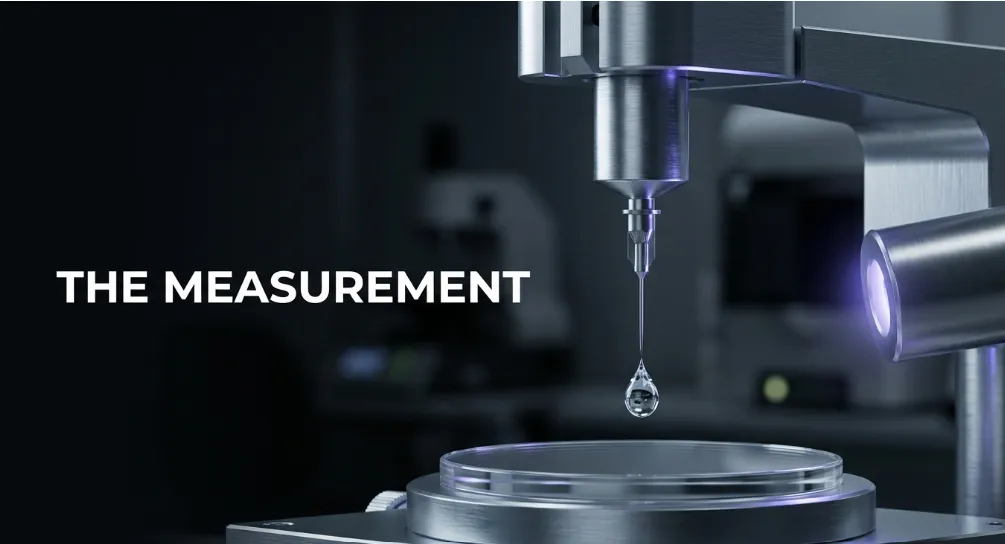
Water contact angle shows how a droplet behaves on a treated glass surface. The result helps engineers evaluate coating quality, uniformity, and durability.
A higher angle generally indicates stronger hydrophobic performance after anti-fingerprint or anti-glare coating. Manufacturers use the water contact angle test to confirm coating consistency across each production batch.
Why Do 3C Manufacturers Rely On This Measurement So Heavily?
Smartphone cover glass, including Corning glass, sapphire glass, and foldable ultra-thin glass, must resist fingerprints and everyday wear. Consistent water contact angle data confirms coating quality before glass ships to a device assembler.
What Industry Benchmarks Apply To Cover Glass Coatings?
A typical industry requirement calls for a hydrophobicity angle exceeding 110 degrees on treated cover glass surfaces after AF, AG, or AR coating. Falling below this threshold often signals uneven coating application or insufficient surface preparation before coating.
Foldable ultra-thin glass adds an extra requirement, since the coating must maintain its contact angle performance through repeated folding cycles without cracking or thinning at the fold line.
How Is Coating Durability Verified After Abrasion Testing?
Contact angle goniometers measure angle degradation after a sample undergoes standardized abrasion testing on a test rig. A steep drop in angle after abrasion cycles points to a coating that will not survive real-world handling, as our article on understanding contact angle as a key to evaluate surface wetting explains in more depth.
How Does Plasma Treatment Prepare Glass Before Coating?
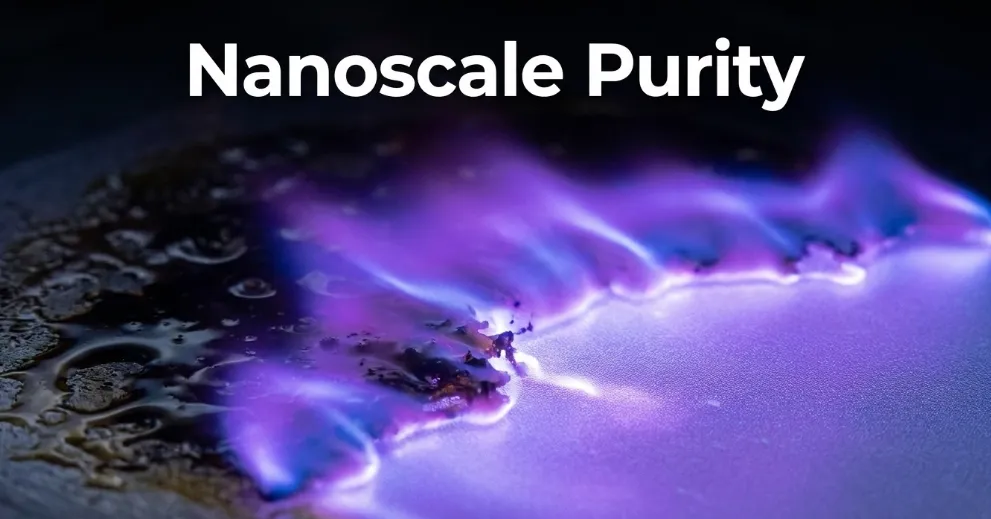
Argon or oxygen plasma removes microscopic oils and fingerprints that washing lines often miss before coating application. Our piece on argon plasma surface treatment for electronics and optics explains how it also activates the glass surface at a nano scale, creating anchor points for anti-fingerprint or anti-glare layers.
This activation step matters as much for sapphire and foldable ultra-thin glass as it does for standard cover lenses. Our guide on improving hydrophilicity of glass using plasma covers the parameters that control this activation step.
What Automation Options Support High-Volume Glass Treatment?
Automatic X, Y, Z-axis plasma treatment systems, such as the PL-A6150, move a nozzle across cover glass panels with repeatable precision. Professional motion control platforms paired with PLC and touchscreen controls support customizable travel ranges for different glass sizes.
This level of automation matters most when a single production line must switch between multiple cover lens sizes without a lengthy manual changeover between batches.
How Should Buyers Evaluate Glass Treatment Equipment?
Confirm the treatment platform’s travel range matches your largest and smallest cover lens dimensions in current production. Request a sample treatment report showing water contact angle before and after processing on your actual glass substrate.
What Does A Practical Glass Manufacturing Scenario Look Like?
A cover lens supplier for smartphone assemblers was seeing inconsistent anti-fingerprint coating performance during customer acceptance testing. Water contact angle measurements showed treated panels varied well outside the target range across a single batch.
Adding an automated X, Y, Z-axis plasma treatment step before coating brought contact angle values into a tight, repeatable range. Customer rejection rates dropped in the following quarter after the change.
What Mistakes Should Manufacturers Avoid With Glass Treatment?
Do not test only new samples and skip post-abrasion verification before shipment. A coating can look excellent on day one and still fail durability requirements down the line.
Avoid assuming manual plasma treatment scales to high-volume 3C production. Automated motion control keeps treatment uniform across large batches in a way manual passes cannot match consistently.
How Does KeyLink Support Cover Glass Quality Control?
KeyLink Technology supplies automated plasma treatment platforms, including the PL-A6150, designed for the precision demands of 3C electronics and glass manufacturing. KeyLink has supported top global brands including Apple, Huawei, and Foxconn, backed by ISO9001, CE, and ETL certification.
Contact our team to discuss cover glass treatment for your production line.

Frequently Asked Questions
What water contact angle range indicates good anti-fingerprint coating performance?
Many manufacturers target above 110 degrees for hydrophobic cover glass coatings, though exact targets depend on the specific coating chemistry used.
Does plasma treatment work on both glass and sapphire cover lenses?
Yes. Argon and oxygen plasma treat both glass and sapphire surfaces effectively, since the cleaning and activation mechanism does not depend on hardness.
How is coating durability tested after plasma pretreatment?
Technicians run standardized abrasion cycles on treated samples, then remeasure water contact angle to check how much the coating has degraded.
Can automated plasma systems handle foldable ultra-thin glass?
Yes, when the treatment platform’s travel range and nozzle configuration are matched to the thinner, more flexible substrate during setup.