Customer Challenge
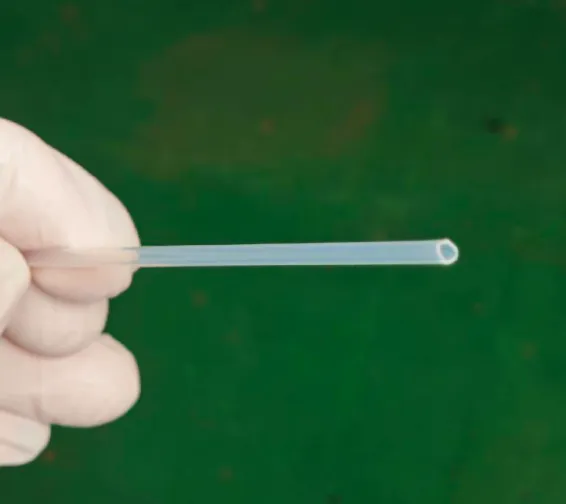
PTFE (Polytetrafluoroethylene) is widely used in medical devices, electronics, and precision industrial applications due to its exceptional chemical resistance and low coefficient of friction. However, its extremely low surface energy makes it one of the most difficult polymers to print, bond, or coat. Conventional surface preparation methods often fail to produce stable, high-quality adhesion without damaging the material.
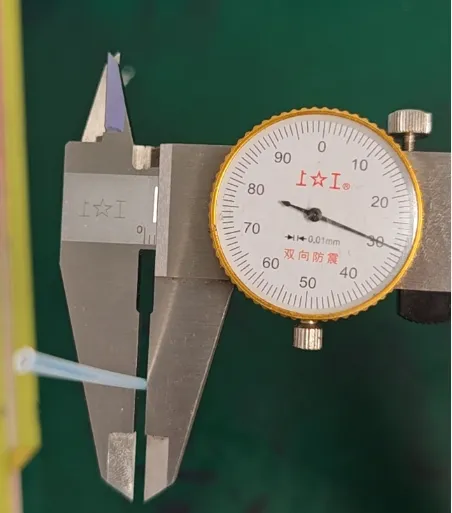
A customer required reliable ink printing on PTFE tubes with an outer diameter of only 2.3 mm. The printed parts were required to achieve a water contact angle below 80° while successfully passing a demanding 400-cycle alcohol resistance test.
Plasma Process Development
To meet these requirements, the application was developed using a Keylink Vacuum Plasma System with a two-stage plasma treatment process.
The first stage consisted of a 180-second pre-treatment using a gas mixture of 95% argon (Ar) and 5% hydrogen (H₂).
This plasma effectively removed organic contaminants, processing residues, and weak boundary layers from the PTFE surface.
The addition of hydrogen enhanced the cleaning efficiency by assisting in the reduction of surface oxides and improving contaminant removal.
Following the cleaning stage, the tubes were activated using 100% ammonia (NH₃) plasma.
The ammonia treatment time was varied up to a total process duration of 840 seconds to evaluate the influence of treatment time on surface activation.
NH₃ plasma introduces nitrogen-containing functional groups onto the PTFE surface while simultaneously increasing the material’s surface energy.
This chemical modification significantly improves wettability and creates active sites for durable ink adhesion.
The optimized process produced excellent and highly repeatable treatment results.
Surface Activation Performance
Untreated PTFE exhibited a water contact angle of ≥104°, confirming its highly hydrophobic surface characteristics.
After only 300 seconds of NH₃ plasma treatment, the contact angle decreased dramatically to ≤7.0°.
This reduction represents an increase in surface energy sufficient for excellent wetting by printing inks.
The relationship between ammonia treatment time and contact angle is illustrated in the accompanying process chart.
As treatment time increased, the contact angle gradually decreased until maximum surface activation was achieved.
The treated PTFE surface demonstrated excellent ink wettability and uniform surface characteristics.

Storage Stability
Following plasma treatment, the activated samples were stored under normal laboratory conditions to evaluate surface ageing.
Immediately after treatment, the contact angle measured approximately 7.0°.
After one minute of storage, the surface maintained its maximum activation level.
As expected for fluoropolymer materials, partial hydrophobic recovery gradually occurred during storage. After 48 hours, the contact angle increased to approximately 41.46°.
Despitethisincrease,thecontactangleremainedwellbelowthecustomer’sspecificationoflessthan80°.
This confirmed that the activated surface retained sufficient surface energy for subsequent printing operations.
When stored under temperature-controlled, clean conditions, the ageing process can be significantly slowed.
Under these optimized storage conditions, the processing window can be extended by many additional days without compromising adhesion performance.
This provides manufacturers with greater flexibility between plasma treatment and downstream production processes.

Customer Results
The plasma-treated PTFE tubes fully satisfied the customer’s printing requirements.
All treated components achieved a contact angle well below the required 80° threshold.
Printed samples successfully passed the specified 400-cycle alcohol resistance test, demonstrating excellent ink adhesion and long-term durability.
The process also delivered highly consistent treatment quality across the entire tube surface.
To Summerize:
The Keylink Vacuum Plasma System successfully combined efficient plasma cleaning with advanced chemical surface activation in a single optimized process.
The Ar/H₂ pre-treatment effectively removed surface contamination, while the 100% NH₃ plasma created a highly active, high-energy PTFE surface.
The optimized plasma recipe reduced the water contact angle from ≥104° to ≤7.0° after only 300 seconds of NH₃ treatment.
Even after 48 hours of storage, the contact angle remained at only 41.46°, comfortably meeting the customer’s process specification.
This case study demonstrates that Keylink Vacuum Plasma Systems provide a reliable and repeatable solution for activating PTFE components, improving ink adhesion, extending production flexibility, and delivering long-lasting surface performance for demanding industrial applications.