When you are manufacturing high-end electronics, cleaning is a dangerous step. If you use chemical solvents, you risk leaving a residue that kills conductivity. If you switch to oxygen plasma to burn off the dirt, you risk oxidizing the copper or silver you are trying to protect. It is a classic catch-22.
This is why argon plasma treatment has become the default solution for high-stakes production. It solves the problem by opting out of chemistry entirely. Instead, it uses pure physical force to blast away contaminants, cleaning delicate microchips and lenses without changing the atomic structure of the material underneath.
The Physics: It’s Kinetic, Not Chemical
To understand why argon works, you have to look at how it differs from the more common oxygen or hydrogen plasmas.
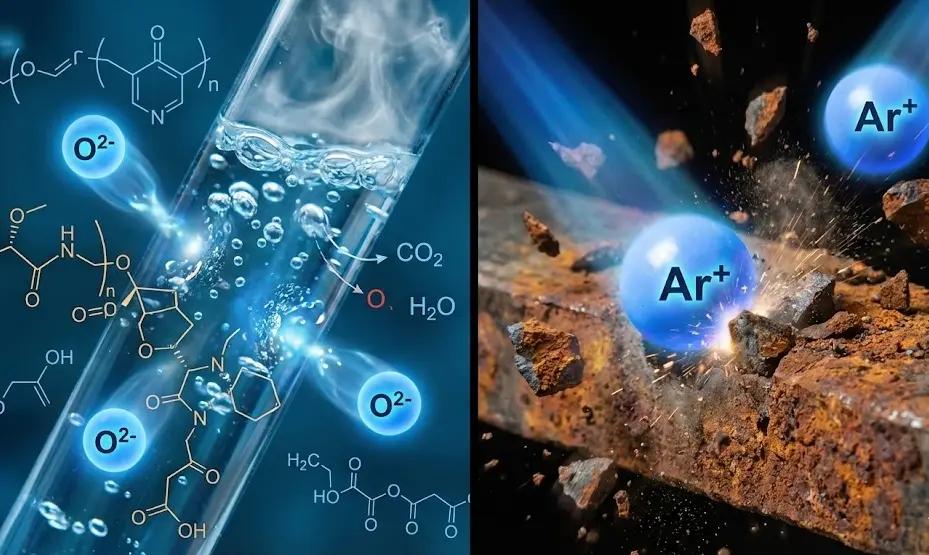
Oxygen plasma is a chemical process; it reacts with organic oils and turns them into gas. That is perfect for plastic, but it is disastrous for silver or copper because it effectively turns conductive metal into rust.
Argon is different. It is a noble gas, which means it is chemically “lazy.” It refuses to bond with anything. When you ignite argon in a vacuum chamber, you aren’t creating a chemical bath—you are creating a bombardment zone.
Think of the argon ions as microscopic billiard balls. Since argon is a heavy atom, it carries a lot of mass. When the electric field accelerates these ions, they smash into the surface with significant kinetic energy. Engineers call this “sputtering” or “ablation,” but in simple terms, it is a physical hammer. It knocks the dirt loose through impact alone, leaving the sensitive metal underneath completely untouched.
The Electronics Problem: Removing the “Rust”
In semiconductor manufacturing, quality is everything. One of the biggest headaches in this sector is wire bonding—the step where microscopic gold or copper wires are welded to the pads on a silicon chip.
These metal pads are often made of copper or silver, materials that love to oxidize. Even a few minutes of exposure to factory air can create a thin tarnish that prevents the wire from sticking.
If you tried to clean this with oxygen plasma, you would simply create a thicker layer of oxide, ruining the part.
This is where argon plasma surface treatment of metals becomes the only viable option. The heavy argon ions smash into the metal surface and physically knock the oxide atoms loose, stripping the metal back to its pure, elemental state. This results in a “fresh” surface with high surface energy, which is perfect for bonding.
By using argon, manufacturers can guarantee that the wire bond will hold without risking the electrical conductivity of the chip. It cleans the metal without changing what the metal is.
The Optics Application: Grip Without the Fog
The optical industry faces a different challenge. It isn’t about conductivity; it is about clarity and adhesion. Whether it is a camera lens or a fiber optic cable, glass needs to be absolutely pristine before any anti-reflective or hydrophobic coating is applied.
Argon plasma surface treatment in glass material solves two problems at once. First, it knocks away organic residues, such as microscopic oils from fingerprints, that washing lines might miss. Second, and more importantly, it “activates” the glass. The kinetic bombardment creates a nano-scale roughness on the surface.
While “roughness” sounds bad for a lens, at the nano-level, this texture is invisible to the eye but acts like a primer for coatings. It creates more surface area for the coating to grab onto, anchoring it deeply into the glass structure.
This prevents the coating from peeling or delaminating over time. Unlike chemical primers that can leave streaks or haze, argon plasma modifies the glass surface itself, ensuring the lens remains crystal clear.
Why You Need a Vacuum System
You generally cannot run a pure argon process in the open air. If air gets in, oxygen gets in, and you lose the inert benefit. You need a controlled environment.
This is why systems like KeyLink’s vacuum plasma machines are essential for this process. These units pump the air out of a sealed chamber until it is nearly empty, then backfill it with pure argon gas.
The vacuum does more than just keep the air out; it increases the “mean free path” of the ions. In a crowded room (atmospheric pressure), you can’t run very fast before bumping into someone.
In an empty hallway (vacuum), you can sprint. The vacuum allows argon ions to accelerate to high speeds without crashing into other gas molecules. This speed gives them the kinetic energy needed to dislodge stubborn contaminants.
KeyLink’s systems allow operators to fine-tune this energy, letting you crank it up to blast heavy oxidation off a steel bracket, or dial it down to gently clean a sensitive sensor.
When is Argon the Right Choice?
Choosing a plasma gas comes down to material science. If you are cleaning plastic, oxygen is usually faster and cheaper. But if metal is involved, argon is mandatory.
When evaluating a treatment argon plasma protocol, the rule is simple: if the material is sensitive to oxidation, use argon. It is the standard for medical implants because it cleans titanium without altering its biocompatibility. It is the standard for aerospace electronics because it ensures connectors won’t fail at 30,000 feet.
There are also hybrid approaches. Some advanced gas plasma treatment recipes mix a tiny amount of hydrogen with argon. The hydrogen chemically reduces the oxide while the argon physically knocks it away. However, for general-purpose cleaning of sensitive materials, pure argon remains the safest and most effective tool in the engineer’s kit.
Conclusion
Argon plasma works because it brings brute force to a delicate environment. It uses the physical weight of the atom to hammer away contamination, yet its chemical inertness ensures the product stays safe. That specific combination—high kinetic energy with zero chemical reactivity—is something solvents and reactive gases just can’t offer.
Whether you are bonding gold wires in a semiconductor or coating a telescope lens, argon gives you a pristine surface without the risk of oxidation. For manufacturers using KeyLink’s vacuum systems, it turns a complex cleaning problem into a simple, repeatable physics equation.