Copper alloys are widely used in electrical, electronic, automotive, and precision engineering applications where excellent conductivity, appearance, and surface quality are essential. During rolling, stamping, storage, and handling, the material surface often becomes contaminated with rolling oils, oxidation residues, organic compounds, and airborne particles. These contaminants not only reduce adhesion performance but also diminish the natural metallic brightness of the copper surface. In this customer project, the primary objectives were efficient removal of surface contamination and a visibly brighter, cleaner surface finish prior to downstream processing.
The solution was provided by the Keylink Atmospheric Plasma System equipped with a specially designed rotating plasma torch (H2 Deoxidizer Plasma Torch). The standard rotating plasma torch features a 40 mm flame diameter, while larger torch configurations with flame diameters up to 100 mm are available to accommodate wider sheet and coil applications. The rotating plasma design ensures highly uniform energy distribution across the treatment area, resulting in consistent cleaning performance and excellent process stability.
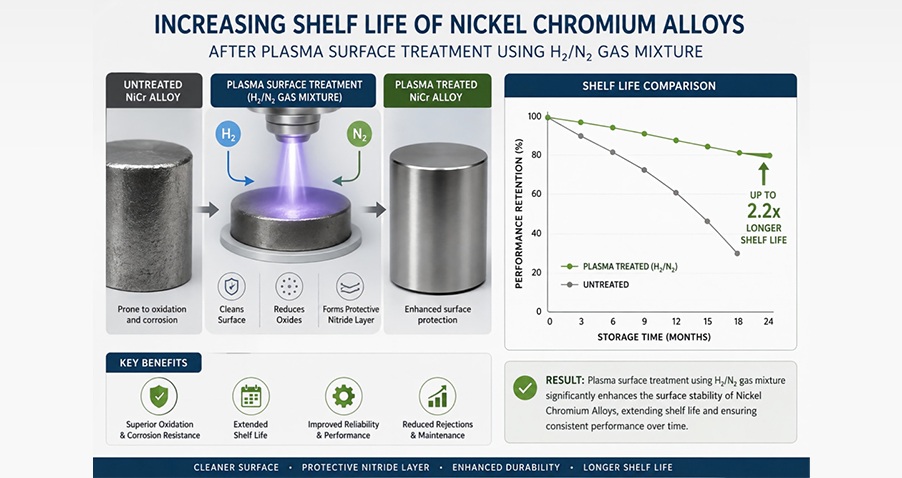
The copper alloy sheets and rolls had a thickness of 0.125 mm and were processed using a gas mixture consisting of 5% Hydrogen (H₂) and 95% Nitrogen (N₂). Hydrogen effectively reduces thin oxide layers and assists in removing hydrocarbon contamination, while Nitrogen stabilizes the plasma discharge for reliable and repeatable operation. The atmospheric plasma process removes contaminants at the molecular level without mechanical contact, preserving the integrity of the thin copper material.
The initial processing speed was 10 mm/second using a single rotating plasma torch. Depending on the selected gas mixture, process parameters, and cleaning requirements, higher production speeds can be achieved. For high-volume manufacturing, a second or third rotating plasma torch can be installed in a vertical arrangement, significantly increasing throughput while maintaining excellent cleaning uniformity.
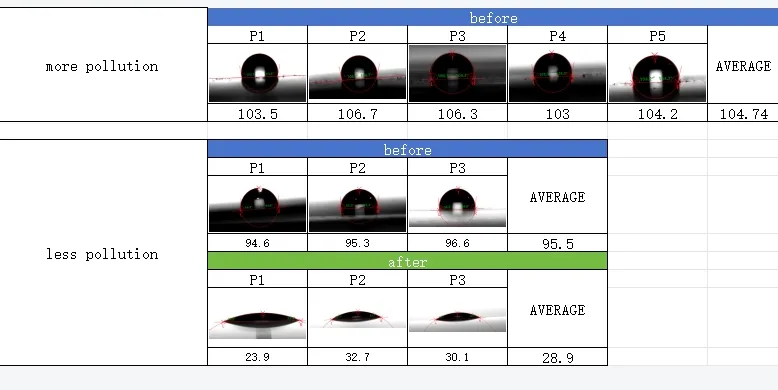
The cleaning performance was verified by contact angle measurements before and after plasma treatment. More heavily contaminated samples exhibited an average contact angle of 104.74°, while less contaminated samples showed an average of 95.5° before treatment. Following plasma treatment, the average contact angle was reduced to 28.5°, as illustrated in the attached chart. This substantial reduction confirms the effective removal of surface contamination and a significant increase in surface energy.
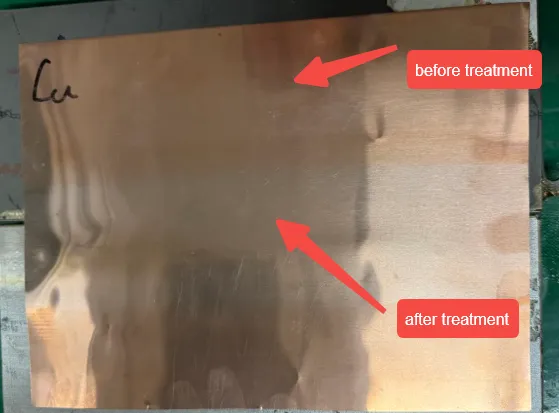
In addition to the measurable improvement in wettability, the customer observed a noticeably brighter and more uniform metallic surface appearance after treatment. The removal of surface films and light oxide contamination restored the natural luster of the copper alloy, helping the material meet both technical and visual quality requirements. The cleaner, brighter surface also provided improved conditions for coating, printing, soldering, welding, and adhesive bonding.
To Summerize
This case study demonstrates how Keylink Atmospheric Plasma Systems combine advanced rotating plasma technology, optimized H₂/N₂ gas chemistry, and scalable production capability to deliver outstanding cleaning performance for copper alloy sheets and rolls. The system not only improves surface energy and adhesion characteristics but also enhances the visual appearance of the material, enabling manufacturers to meet demanding customer specifications while increasing production efficiency through flexible multi-torch configurations.
Contact Angle Improvement after Plasma Surface Treatment